A rock has a start, a finish and one name on it
I see the same thing every quarter. A founder and their team spend an afternoon setting out the plans, everyone goes home full of energy, and in week three the biggest customer rings with a problem. By week six nobody can quite remember what was decided. At the end of the quarter a bit of work has gone into everything and not much is finished.
The plan was usually fine and the team worked hard. The problem is what's on the list. A quarterly plan with twelve points is a to-do list, and a to-do list always loses to whatever comes in today.
What a rock is
A rock is a quarterly priority: one outcome that's finished by the end of the quarter, with one owner. The name comes from Scaling Up and EOS. If you want to fill a jar with rocks, gravel and sand, you put the big rocks in first, or they won't fit. In Boldcaster, rocks and OKRs together are called priorities.
The way I usually explain the difference from ordinary work: a rock has a start and a finish. It begins somewhere and it's done somewhere. Work without a start and a finish is an operational process, and you follow that on your KPI scoreboard. Doing six intake calls a week is a KPI. "Every new customer goes through the same steps, from first contact to renewal, and every step has a name next to it" is a rock. Once it's done, your business works differently for good.
All the rocks in a year, added up, should deliver your strategy for that year. That's how you and your team actually carry out a strategy, and how you can see who's falling behind. I wrote about the difference between hitting targets and carrying out a strategy in you're hitting your targets, but are you executing a strategy?
How many fit in a quarter
In a small team, three, five at the most. With a full leadership team you can get to five or six, because there are more people who can each carry one. I've never seen more than that work anywhere.
Boldcaster doesn't block anything if you go over. In a team of fewer than five people the screen adds a note above five priorities; in a larger team, above six. I used to have that conversation by hand with every client, and it belongs in the app.
One owner, even when five people are working on it
"We'll pick that up together" is the sentence most quarterly goals start dying with. If the owner is "the sales team", nobody blinks at a delay in week six.
One owner doesn't mean that person does all the work. They keep the overview, hand out the tasks, raise the alarm when it gets stuck, and they're the one you look at in the weekly meeting. In the app every priority has one owner, with tasks underneath that each have their own owner and deadline. Those tasks turn up in the backlog of your Week sprint by themselves, under "From your priorities". You drag them into the week you'll pick them up, so the work on your rock sits next to the day-to-day work every week.
Write down the finish before you start
"Improve the website" is a wish. You never know when it's done, so it's never late either. You write a rock as the situation at the end of the quarter: "The new website is live, the ten most important pages have new copy, and every contact form that's filled in lands in the CRM." On 31 March you can answer that with a yes or a no.
If something is too big for one quarter, cut it up. Opening a new location doesn't fit into thirteen weeks. Choosing the site and signing the lease does. The next piece becomes a rock for the following quarter.
By week seven you can see who's behind
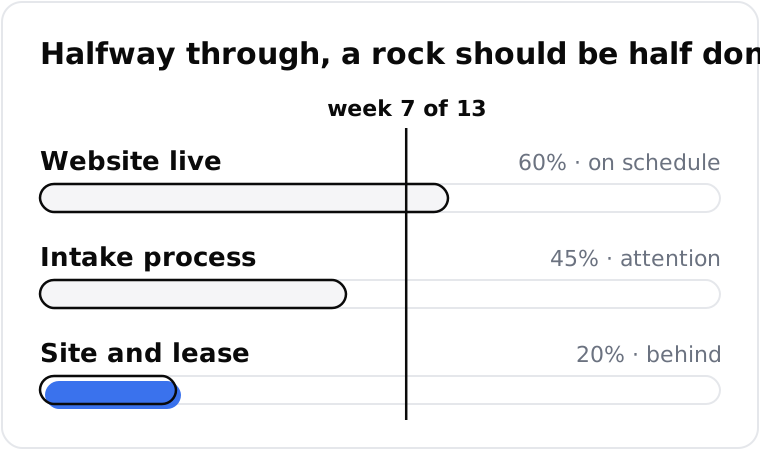
A rock you only discuss in the last week can't be rescued. That's why Boldcaster puts two things side by side for every priority: how much is done, and how much of the quarter has gone. Halfway through the quarter, a rock should be roughly halfway done.
Progress comes from the tasks underneath. A completed task counts according to how big you estimated it, so a job of a few days weighs more than a phone call. If you're on the line or above it, you're on schedule. If you've reached at least 80 per cent of the line, the rock needs attention. Below that, you're behind. It's the same rule the KPI scoreboard uses.
In week 7 of 13, 54 per cent of the quarter has gone. If the website is at 60 per cent, it's on schedule. The intake process at 45 per cent needs attention, and the site and lease at 20 per cent are behind.
That changes the conversation. You don't have to ask how it's going, because you can see it. The question in the weekly meeting becomes what's needed to get back on schedule, and you still have six weeks to do something about it.
From my own work
At one client, thirteen rocks were in the app after the first quarterly session. They were all good things: supporting customers, scheduling the team's training, writing a handbook. But most of it was the work they already did every week, and that never ends. Thirteen rocks mostly tell you that you're busy.
We turned the ongoing work into projects and kept three rocks that would really move the business on. The handbook became a project with a subtask for each chapter. In Bold Pro and Bold Black you can now turn a rock into a project yourself. The tasks, comments and logged hours stay where they are. A project carries on across quarters; a rock belongs to one quarter.
What I noticed afterwards was that the weekly meeting got shorter. You can talk through three rocks in ten minutes. Thirteen take an hour, and nothing gets decided.
Your first three
Take your current list of quarterly goals and ask one question of each point: does this finish somewhere? Anything without an end goes on your scoreboard or becomes a project. From what's left, pick three, and for each one write down the finish and one name.
The growth scan shows you in twelve questions where your business stands now, free and without a call. If you'd like to set up your first quarter with me, with your own list on the table, start with the scale-up audit.
Ready to build this for your company?
Start with a free audit: an honest picture of your strategy, execution and people.
Start the audit