A good KPI is one you can move on Monday morning
Ask a founder about their KPIs and you'll usually get one of two answers. A spreadsheet with forty rows nobody has updated since the summer, or the balance in the bank account. Both tell you something, just too late to do anything about it.
A KPI is a number you write down every week or month because you want to steer by it. That last part is the whole point. A figure that doesn't make anyone do anything differently when it disappoints isn't worth keeping.
I always set up KPIs with a team in the same three steps.
Step 1: what should come out of the process
A list of a hundred possible KPIs from the internet won't get you anywhere. Start with your processes: marketing, sales, delivery, support. What comes out of each one when it's running well? For sales, that's deals won; for support, customers who stay happy. That's your result KPI, the number you look back on at the end of the quarter.
One or two per process is plenty. Anyone with more stops looking at any of them after a month. How process, result and driver fit together is covered in detail in the KPI hierarchy.
Step 2: ask the person doing the work what drives the result
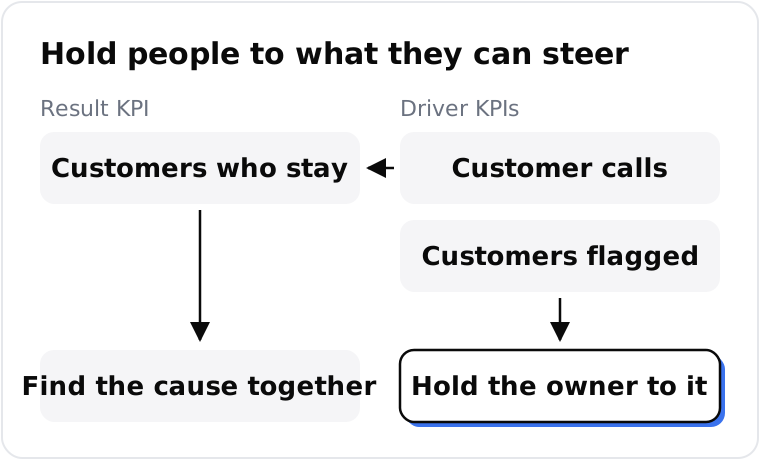
It's hard to hold someone to a result KPI, and this is where things go wrong between people in a lot of businesses. A founder who gets cross with their account manager because three customers cancelled this month will hear that she couldn't have done anything about it. She's often right. Whether a customer leaves also depends on the product, the price and the new buyer on the other side.
What she does control is how many customer conversations she had, and how many customers she flagged before it was too late. Those are driver KPIs: the behaviour that drives the result, and that the owner can influence. You can hold someone firmly to a driver KPI. If the result KPI disappoints while the driver KPIs were hit, you look for the cause together, and at least you know the work was done.
Let the person who does the work set the driver KPIs. Ask your account manager which number tells her on a Friday that it was a good week. She knows better than you what makes the engine run, and people defend a number they chose themselves.
In Boldcaster you hang a driver KPI under a result KPI, and that under a process. If a driver KPI has no owner of its own, it takes the owner of the result KPI above it, and failing that, the owner of the process.
Step 3: an owner, a norm and a rhythm
A KPI without a norm is a number without meaning. Are fourteen quotes in a month good? You only know once you've agreed it should be twelve.
Then you decide how to read the number, because not every number can be added up. The KPI scoreboard knows four kinds:
- A counter adds up: quotes, new customers, revenue. Four weeks of 10 is 40.
- A level doesn't add up: headcount, stock. Four weeks of 100 is 100.
- Growth is a level with a starting point: from 100 to 130 customers is a target of 30 more.
- A ratio is a proportion: win rate, margin, churn. Four weeks of 25% is still 25%.
And you choose how often you measure: weekly, monthly or quarterly. If you measure customer satisfaction from a handful of responses, a weekly figure swings all over the place as soon as one customer is unhappy. Measure that one quarterly, once the quarter is over.
For a counter, the scoreboard puts your figure next to what should be there at this point in the quarter. Hit that and you're within target. At 80 per cent of it or more you're just off target, and below that, off target. So you see it halfway through the quarter, not in the last week.
The story belongs with the number
A number without an explanation invites a watermelon: green on the outside, red on the inside. Anyone who has worked in an organisation long enough knows the report that looks fine on paper and still comes with a long story in the meeting.
That's why Boldcaster asks for a note as soon as a KPI goes just off or off target. The owner types the story in when they enter the figure, and anyone who opens the scoreboard reads it straight away. If a number suddenly shoots up, the entry window asks what happened there too. At one client, revenue more than doubled in a single week, and a month later nobody could remember how it had come in. That's where the question came from.
If you record things properly, you don't have to keep meeting about everything. In the weekly meeting you then only talk about what's off target, and the rest of your time goes to your customers.
From my own work
At a small business where I set up the scoreboard with the team, there was one revenue target for the whole quarter. Everyone thought it mattered and nobody felt they owned it. We turned it into an amount per week, per person. One of them mostly brought in new work and the other mostly did the work itself, so their weekly amounts differed. Since then each of them can see on a Monday whether they're ahead or behind, and the scoreboard works out for itself whether the quarterly target is still within reach.
What I liked most was what happened to the Monday conversation. From then on it was about what was needed that week to catch up.
The same works for cash. In the article on the cash conversion cycle I show how debtor days, as a driver KPI, turn your profit into money in the bank.
Start with one process
Pick the process that's pinching most right now. Write down one result KPI, ask its owner for two driver KPIs, agree the norm and enter them every Monday for four weeks. By then you'll know whether they're the right numbers.
The growth scan shows where the rest of your business stands: twelve questions, free. If you'd like to set up your scoreboard with me, with your own processes on the table, start with the scale-up audit.
Ready to build this for your company?
Start with a free audit: an honest picture of your strategy, execution and people.
Start the audit