Every day your invoice is unpaid, you're your customer's bank
I know very few founders who have never opened their banking app the day before payroll with a knot in their stomach. Revenue is coming in, the profit is in the numbers, and still the money isn't there. Usually the books are fine. The cash is tied up: with your customers, in work you haven't invoiced yet, or in stock on the shelf.
How much cash that is, and for how long, is what the cash conversion cycle measures. An ugly name for a simple question: how many days pass between the moment you spend a euro and the moment it's back in your account?
Three places your cash gets stuck
With your customers. You've done the work and sent the invoice, but the money hasn't arrived. The average number of days a customer takes to pay is your debtor days.
In your work or your stock. For a wholesaler it sits on the shelf. For a services business it sits in hours already worked but not yet invoiced: work in progress. A three-month project you only invoice on delivery is three months of salaries you're paying up front.
With your suppliers, the other way round. How long you take to pay your own bills. Those days work in your favour, so you subtract them.
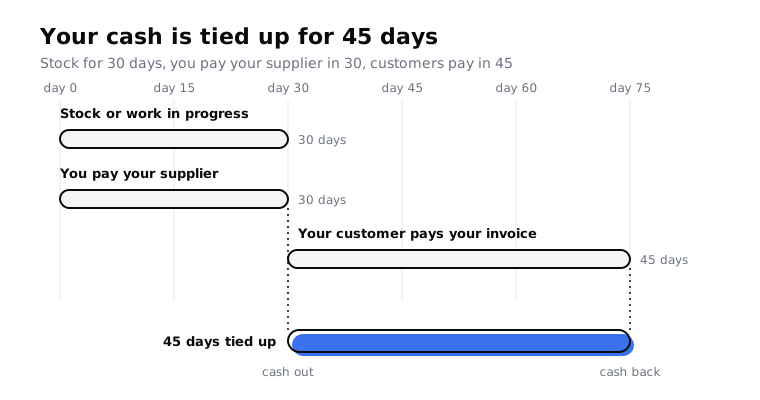
The sum is debtor days plus stock days minus creditor days. If your customers pay in 45 days, your stock sits for 30 and you pay your suppliers in 30, every euro is tied up for 45 days. For a month and a half, you're financing your customer's business.
Include VAT, or you'll count too many days
This is where almost everyone who works it out themselves goes wrong. The debtors on your balance sheet include VAT; the revenue in your P&L doesn't. Divide one by the other and you count the VAT as days. Customers who really pay in 37 days show up as 45.
That's why Boldcaster's Finance module works out revenue per day including VAT: your revenue times 1.21, divided by 365. Creditors work the same way with your purchases. The days then match what your customers actually do, and you can put them next to your payment terms.
And then the number that matters: what does collecting one day sooner give you? On €5 million of revenue, one day of revenue including VAT is about €16,600. Collecting ten days sooner frees up more than €165,000, once, without a single extra customer. Levers shows you that for each lever on your own numbers, along with what it does to your cash, your profit and your company's value.
From my own work
A staffing firm I worked with always invoiced in arrears. February's hours went out in mid-March, on 60-day terms. The money arrived at the end of May: three months of pre-financing, every month again.
They switched to invoicing in advance. February's hours went out at the end of January. That saved two months, and on annual revenue of €7 million, two months of revenue is almost €1.2 million in the bank sooner. Money they no longer had to borrow.
At a consultancy where I'm now helping build the processes, we did the same thing, a little more gently: 70 per cent invoiced when the order is placed, 30 per cent on delivery. Customers find that normal, as long as it's in the quote and not sprung on them afterwards.
Three levers that actually work
- Invoice sooner. In advance, in instalments, or monthly instead of per project. This is the biggest lever and it costs you nothing but one conversation with your customer.
- Invoice so it can be paid straight away. An invoice without a purchase order number sits in your customer's accounts payable for thirty days, and you only find out when you call. At that consultancy, the customer's purchase order number therefore counts as acceptance of the quote: no signature needed, and the invoice is right first time. Call a new customer after five days to check the invoice arrived.
- Look at your business model. A subscription or a prepaid bundle of hours brings the money forward. You get paid for what you're going to do rather than what you've already done.
You can also pay your suppliers later, but I'd be careful. A few extra days don't add up to much, and a good supplier is easily lost.
Put it on your scoreboard
Cash is a result. You steer it through what drives it, and debtor days is the best of those. Put it on your KPI scoreboard as a driver KPI, measure it monthly and agree a norm, say your own payment terms plus five days. How result KPIs and driver KPIs fit together is in the KPI hierarchy.
It also feeds into what your company is worth. A buyer looks at how much working capital you need to run your revenue, and every day less is money they don't have to buy along with it. More on that in what is your company worth.
Where to start
Work out your days once with last quarter's numbers, VAT included. If the figure is well above your payment terms, you know where your first month goes.
If you want to know where the rest of your business stands, take the growth scan: twelve questions, free, and you'll see straight away what to work on first. If you'd rather go through it with me, with your own numbers on the table, the scale-up audit is the place to start.
Ready to build this for your company?
Start with a free audit: an honest picture of your strategy, execution and people.
Start the audit